Net 15 vs Net 30 vs 2/10 Net 30: Payment Terms Explained
Compare Net 15, Net 30, and 2/10 Net 30 with clear deadlines, a worked discount example, and practical invoice wording for US service businesses.
On this page
Payment terms tell a customer when to pay and whether paying early changes the amount owed. For a freelancer covering project expenses or an agency meeting payroll, that timing matters as much as the invoice total.
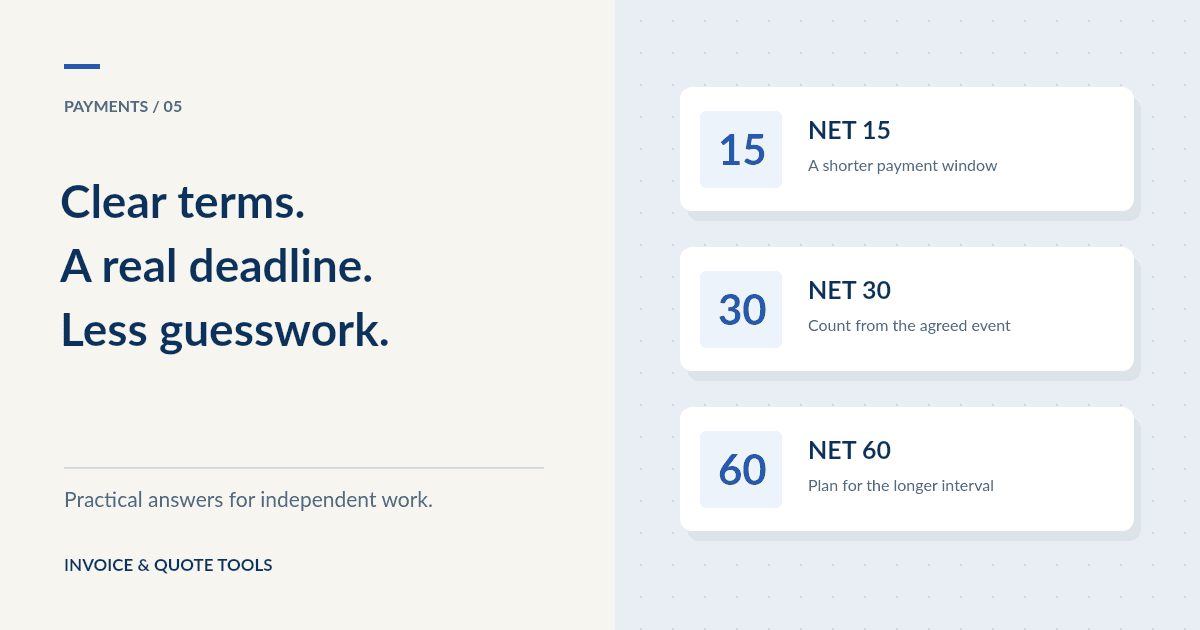
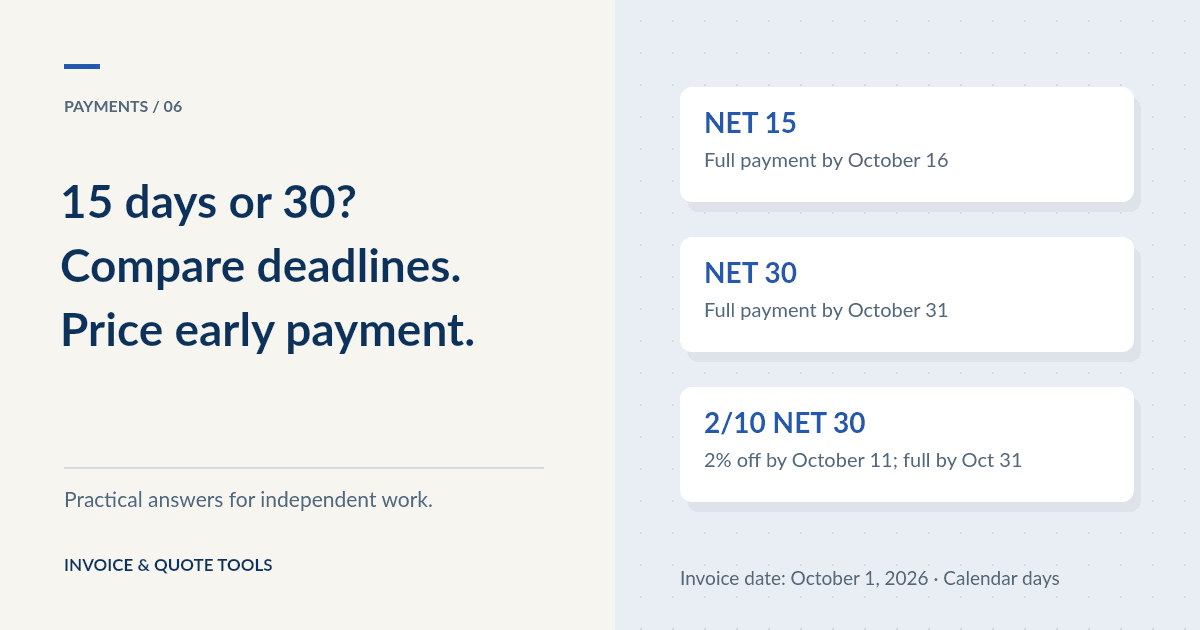
- Net 15 means full payment is due within 15 calendar days.
- Net 30 means full payment is due within 30 calendar days.
- 2/10 Net 30 means a 2% discount is available for payment within 10 days; otherwise, full payment is due within 30 days.
These interpretations assume the invoice date starts the payment period, unless the contract specifies otherwise. All examples below count elapsed calendar days from October 1, 2026, without a weekend or holiday adjustment. Agree on the starting event, counting rules, and actual deadlines before issuing the invoice. Contract terms and applicable law may change how a particular invoice works.
What Does Net 15 Mean?
Net 15 payment terms give the customer 15 calendar days from the agreed starting date to pay the full invoice balance. There is no early-payment discount built into the term.
For a $1,200 invoice dated October 1, 2026, Net 15 from the invoice date produces a due date of October 16, 2026. The customer owes $1,200 by that date.
The benefit for the seller is a shorter gap between billing and the payment deadline. This can suit independent designers, consultants, small service businesses, and agencies billing short projects or regular milestones. It is particularly useful when the client can approve the work and arrange payment promptly.
The limitation is the client's process. If an invoice needs several approvals or misses a scheduled payment run, 15 days may be difficult to meet. A shorter deadline also does not guarantee earlier collection. Confirm that the customer can actually comply before agreeing to Net 15.
What Does Net 30 Mean?
Net 30 payment terms give the customer 30 calendar days from the agreed starting date to pay the full balance. It means 30 days, rather than the last day of the month or one calendar month later.
For a $3,000 invoice dated October 1, 2026, payment is due on October 31, 2026 under Net 30 from the invoice date. October 31 happens to be a Saturday. This example does not move the deadline; check the agreement's weekend rules and arrange payment early enough to arrive on time.
Net 30 can suit established B2B relationships, monthly agency retainers, consulting engagements, and service contracts that pass through accounts payable (AP). The extra time gives the buyer more room to match purchase orders, confirm delivery, and authorize payment.
For the seller, the tradeoff is a longer receivables period. You may need to cover labor, software, or subcontractor costs before receiving the customer's money. Check whether your cash reserve can support that wait, especially when several invoices fall due together.
Net 15 vs Net 30: Core Differences
The central difference in a Net 15 vs Net 30 invoice is the deadline: Net 30 gives the buyer 15 more calendar days. Neither term includes a discount or late fee by itself.
| Feature | Net 15 | Net 30 |
|---|---|---|
| Payment Window | 15 calendar days | 30 calendar days |
| Cash Flow Impact | Faster cash recovery | Longer wait for payment |
| Common Users | Freelancers, small businesses, short projects | B2B companies and corporate clients |
| Buyer Suitability | Frequent or flexible AP cycles | Longer approval and payment cycles |
| Seller Advantage | Earlier payment deadline | More flexible customer terms |
| Main Drawback | May be too short for some clients | Longer receivables period |
The cash-flow comparison assumes the customer pays on time. These are practical fits, not mandatory rules for any business category.
Choose Net 15 when the customer can pay within that window and you want to limit the time your money is tied up. Consider Net 30 when the client's approval process needs more time and you can afford to extend it. For a large project, a deposit or milestone schedule may matter more than choosing between these two deadlines. Our broader invoice payment terms guide also covers advance payments, milestones, and Net 60.
What Does 2/10 Net 30 Mean?
Read the notation in three parts:
- 2 is the percentage discount: 2% of the eligible invoice amount.
- 10 is the early-payment window: pay within 10 days to qualify.
- Net 30 is the final deadline: the full balance is due within 30 days if the discount is not earned.
For a $5,000 invoice dated October 1, 2026, assume the entire $5,000 qualifies and payment must be received by the stated deadline:
| Item | Amount or date |
|---|---|
| Original invoice | $5,000 |
| Discount | 2% |
| Discount amount | $100 |
| Discounted payment | $4,900 |
| Discount deadline | October 11, 2026 |
| Final due date | October 31, 2026 |
The calculation is:
Discount = Eligible Invoice Amount × 0.02
Discounted Payment = Eligible Invoice Amount − Discount
$5,000 × 0.02 = $100; $5,000 − $100 = $4,900.
The customer pays $4,900 by October 11 to qualify, or $5,000 by October 31. October 11 is a Sunday, so the customer should allow for processing time if payment must be received that day. Specify whether receipt or initiation of payment determines eligibility, including any agreed weekend adjustment.
Stripe's payment-terms primer also describes 2/10 Net 30 as a 2% incentive for payment within 10 days.
Discount eligibility for taxes, shipping, and other charges depends on the agreed terms. The $4,900 result assumes no excluded charges; calculate the discount only on the eligible base and check the applicable tax treatment.
If you have seen 2/15 Net 30, the meaning is similar but the discount window is 15 days: 2% off if paid within 15 days, otherwise full payment within 30 days. On an October 1 invoice with the same counting assumptions, that discount deadline would be October 16.
Is a 2/10 Net 30 Discount Worth It?
For the seller
On the $5,000 example, you give up $100 of revenue to encourage receipt of $4,900 up to 20 days before the final deadline. That can help fund operating costs or reduce the need to borrow. It only improves timing if the discount actually changes when the buyer pays.
Compare the $100 cost with your margin and other funding options. If a client already pays within 10 days without a discount, offering one may reduce revenue without speeding payment. A discount can also be expensive on a project with high subcontractor costs and little profit left over.
For the buyer
The buyer saves $100 by paying $4,900 early. Giving up that saving effectively means paying $100 for another 20 days of access to $4,900, assuming payment would otherwise occur on day 30.
The approximate simple annualized cost of foregoing the discount is:
(2 / 98) × (365 / 20) × 100 ≈ 37.2%
Here, 2 is the discount percentage, 98 is the percentage paid after discount, and 20 is the difference between the 30-day final deadline and the 10-day discount deadline. Annualizing scales the 20-day cost to a 365-day year without compounding.
This is a financing comparison, not an automatic invoice interest charge. It does not mean the seller can add 37.2% interest. The buyer should compare the saving with available cash, borrowing costs, and other obligations; taking a discount is less useful if it leaves the business unable to meet essential payments.
Which Payment Terms Should You Choose?
Start with your ability to fund the work and the customer's ability to pay. Discuss terms before accepting the project, and confirm them in the contract or accepted proposal.
| Business or situation | Terms to consider | What to check first |
|---|---|---|
| Freelancers | Net 15 for short projects; Net 30 for reliable clients | Whether your savings can cover the wait and the client can meet the deadline |
| Small agencies | Net 15 or Net 30, possibly with deposits or milestones | Payroll and contractor payment dates relative to collection |
| Established B2B clients | Net 30 when it fits the relationship | Actual payment history and any repeated approval delays |
| Corporate customers | Net 30 if compatible with agreed procurement terms | Vendor onboarding, purchase-order requirements, and payment runs |
| Businesses needing faster cash flow | Net 15, a deposit, or smaller milestone invoices | Whether a shorter deadline alone will change payment timing |
| Businesses offering early-payment discounts | 2/10 Net 30 | Margin, eligible charges, and how earned discounts will be recorded |
| New customers with no payment history | Advance payment, a deposit, or limited credit with Net 15 | Exposure if payment is delayed; avoid extending credit you cannot afford |
No payment term is universally best. A dependable client on Net 30 may be easier to budget for than a client who repeatedly misses a Net 15 deadline. For a new customer, consider limiting the amount of unpaid work as well as shortening the deadline.
How to Write Payment Terms on an Invoice
Use both the shorthand and a specific date. The customer should be able to identify the amount, deadline, and payment method without working through the notation.
This fictional service invoice shows how the details fit together. All amounts are in USD, and no tax or additional charges are included in the example.
| Invoice field | Example |
|---|---|
| Business | Cedar Studio, a fictional design business |
| Invoice number | CS-2026-104 |
| Invoice date | October 1, 2026 |
| Customer name | Maple Consulting LLC, a fictional customer |
| Service description | Website landing-page design and agreed revisions |
| Total amount | $1,200 |
| Payment terms | Net 15 from the invoice date |
| Due date | October 16, 2026 |
| Payment instructions | Pay by ACH using the verified bank details supplied securely. Include reference CS-2026-104. |
Replace the fictional names and reference with your own details. Provide the real payment destination through your agreed secure process. For the remaining invoice fields and a complete workflow, see how to create an invoice.
Copy-ready Net 15 wording
Net 15 from the invoice date of October 1, 2026. Full payment of USD 1,200 is due by October 16, 2026. Pay by ACH using the verified bank details supplied securely and include your invoice number as the payment reference.
Copy-ready Net 30 wording
Net 30 from the invoice date of October 1, 2026. Full payment of USD 3,000 is due by October 31, 2026. Pay by ACH using the verified bank details supplied securely and include your invoice number as the payment reference. Allow enough processing time for payment to arrive by the due date.
Copy-ready 2/10 Net 30 wording
2/10 Net 30 from the invoice date of October 1, 2026. A 2% discount applies to the eligible USD 5,000 service fee if payment of USD 4,900 is received by October 11, 2026. Otherwise, USD 5,000 is due by October 31, 2026. No tax, shipping, or other charges are included in this example. Pay by ACH using the verified bank details supplied securely and include your invoice number as the payment reference.
Adapt the amounts, dates, eligible charges, and payment method to your agreement. These examples do not add late fees or override an existing contract.
Create an Invoice With Clear Payment Terms
Use our free invoice generator to put the agreed terms on a PDF:
- Enter your business details.
- Add the customer's billing information.
- Add invoice line items with descriptions, quantities, and prices.
- Set the invoice date and due date to match your agreement.
- Open Payment information and notes, then enter the wording and payment instructions in Payment terms.
- Review the invoice preview, check both dates and the total, and select Download PDF.
For 2/10 Net 30, enter the final due date in the date field and write both deadlines and amounts in Payment terms. The generator's ordinary discount control applies an immediate reduction; it does not automatically calculate eligibility for a future early-payment discount. Keep the full amount on the invoice until the condition is met, and record any earned discount separately in your bookkeeping.
For guidance on sending the PDF and following up with a client, read how to invoice a client as a freelancer.
Frequently Asked Questions
Does Net 15 mean calendar days or business days?
It ordinarily means 15 calendar days unless the agreement specifies business days or a different counting rule. State the actual due date so neither party needs to guess.
Does Net 30 include weekends?
Yes, under calendar-day counting, weekends are included. Whether a deadline falling on a weekend or holiday moves to another day depends on the agreement and applicable rules. Do not assume an automatic extension.
What happens when a Net 30 invoice becomes overdue?
Check that the customer received a correct invoice, then send a reminder with the invoice number, amount, and due date. Ask about disputes or approval holds. Late fees, interest, and further collection steps depend on the agreement and applicable law; Net 30 alone does not create a particular penalty.
Is Net 15 better than Net 30?
Net 15 sets an earlier payment deadline, which may suit a seller with limited working capital. Net 30 gives the customer more processing time. Choose terms that fit your cash needs, the customer's payment process, and the relationship.
What does 2/10 Net 30 mean on a $1,000 invoice?
If the entire $1,000 is eligible, the 2% discount is $20. The customer pays $980 within 10 days to qualify, or the full $1,000 within 30 days, measured from the agreed starting event.
Can freelancers use Net 30?
Yes. A freelancer can agree to Net 30 when it suits the client relationship and they can fund the wait. A deposit or milestone billing can reduce the amount outstanding on a larger project.
What is the difference between Net 15 and Net 30?
Net 15 requires full payment within 15 days, while Net 30 allows 30 days from the same agreed starting event. Net 30 therefore gives the buyer 15 extra days. Neither term includes an early-payment discount by itself.
Does 2/10 Net 30 mean a late payment penalty?
No. It offers a discount for qualifying early payment. Missing the discount deadline means the full invoice amount is due by day 30; any charge after that requires a separate basis under the agreement and applicable law.
When does the Net 30 period begin?
The invoice date is a common starting point and is used in this article's examples. A contract may instead specify receipt of a valid invoice, acceptance of the work, or another event. Make the invoice consistent with that agreement.
Final Thoughts
Net 15 sets a shorter deadline, Net 30 gives the customer more time, and 2/10 Net 30 offers a discount for qualifying early payment. Choose based on your cash needs, margins, and the customer's process, then write the starting event, amounts, and dates clearly.
Create a free invoice with payment terms your customer can follow.
Put the guide into practice.
Create an invoice with your details, choose a professional template, and download your PDF. Free, with no signup.
Create Your Free InvoicePractical guides to using invoices and business documents. Examples are illustrative. Tax, invoicing and payment rules depend on your location and circumstances; check the linked official guidance for your situation.