How to Invoice a Client as a Freelancer
A practical workflow from agreeing billing details to sending the PDF and following up. Includes service-description examples and client email templates.
On this page
Good freelance invoicing starts before you open a template. You need to know who is paying, which work you can bill for, what the client needs to approve it, and when payment is expected. Getting those answers early reduces the avoidable problems that a polished PDF cannot fix.
This workflow is for independent professionals billing a client for services. It covers hourly work, fixed-price projects, and retainers without assuming that every client or country uses the same process. The examples use fictional projects and exclude tax unless stated.
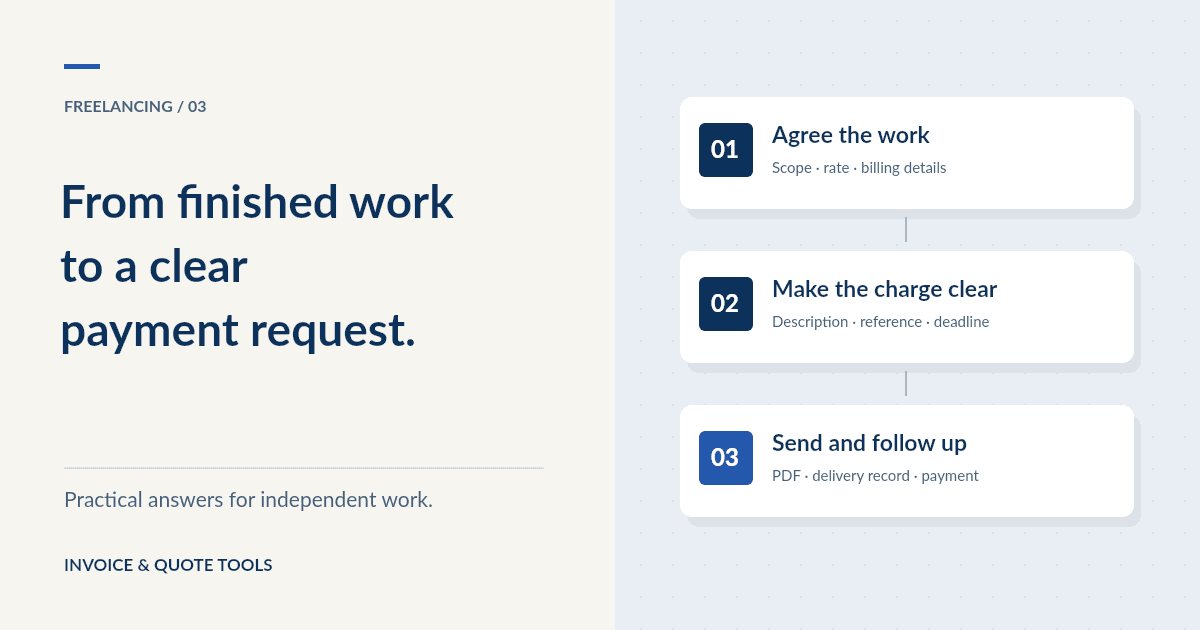
Agree the billing process before starting work
Ask the client how invoices enter their payment process. A small business might accept an emailed PDF; a larger organization might require a supplier account, purchase order, or portal submission. Confirm whether the project manager can approve the charge or whether finance needs separate evidence.
Put the practical billing arrangement in writing:
- The legal customer name, billing address, and accounts-payable email.
- The scope, rate or fixed fee, and currency.
- The deposit or milestones, if any, and the point at which each can be billed.
- The payment terms, accepted method, and required reference.
- Any timesheet, delivery confirmation, or purchase-order requirement.
If the client requires supplier onboarding, finish it before the invoice is due to be sent. Verify changes to bank details through a trusted channel. Do not rely solely on a surprising email asking you to redirect a payment or supply sensitive credentials.
Prepare the client and project details
Check the details against the agreed engagement. A client's brand name, project nickname, and billing entity can be different. If you are subcontracting to an agency, your customer is normally the entity that engaged you, not automatically the agency's end client.
Gather the service period and any accepted deliverable reference. Keep the evidence close to the invoice record: for example, the approved November timesheet or an email accepting the first design milestone. Include enough context for approval without attaching confidential project material unnecessarily.
For the invoice itself, use a unique reference and a numbering system you maintain. If you work with several clients, avoid resetting the same reference for each one unless your full numbering system remains unambiguous and meets applicable rules. Our generator accepts a manual invoice number; it does not issue or reserve numbers for your business.
Write descriptions the client can approve
A good line item names the work and its billing basis. It should connect to something the client already agreed to buy. The invoice is not the place to introduce an unexpected rate or a charge that belongs in a scope-change discussion.
| Billing model | Weak description | Clearer example |
|---|---|---|
| Hourly development | Development | Booking-form implementation, 2–6 November; 12 hours at USD 80 |
| Fixed-price writing | Writing work | Three approved product guides, November content package; fixed fee GBP 750 |
| Monthly retainer | Retainer | November support retainer under agreement dated 15 October; EUR 600 |
| Project milestone | Design | Homepage design, approved milestone 2 of 3; CAD 900 |
For a fixed fee, use quantity one and the agreed total. For an hourly charge, show the hours and rate, and supply the agreed timesheet separately if required. Avoid listing internal tasks that do not help the client understand the deliverable.
Worked hourly example
Suppose you agree USD 80 per hour for an implementation task and complete 12 approved hours. The charge is USD 960 before any applicable tax. A separate fixed-fee handover session of USD 150 brings the subtotal to USD 1,110.
Keep the two billing bases on separate lines. If the customer disputes the hours, you can investigate that line without confusing the fixed handover fee. Do not invent a tax rate for the example; confirm the treatment for your business and transaction before entering it.
Choose terms that match the agreement
Write both the agreed terms and an explicit payment deadline. If “Net 15 from invoice date” is agreed and the invoice is dated 1 November 2026, the illustrative deadline is 16 November 2026. If terms start from receipt or approval instead, use that agreement and identify the starting event clearly.
Add instructions a payer can follow: currency, payment method, verified recipient details, and the invoice reference to quote. State who bears transfer fees if that has been agreed. Do not assume a customer will infer an international transfer arrangement from an account number alone.
Our payment terms guide compares common options. A shorter deadline can suit a small, clearly defined engagement; a client's procurement process may require a different arrangement. Decide before accepting the work rather than changing the deadline when you need cash.
Build and check the invoice PDF
Open the free invoice generator, add your real business and customer details, and enter the reference, dates, and currency. Add your service lines and any appropriate adjustments. Use Payment terms for payment instructions and notes for helpful project context.
You can add a purchase order or service period as a custom field. Choose from the existing invoice templates, then check the actual pages with Review PDF. Verify the reference, recipient, amount, due date, and bank instructions before downloading.
The generator does not determine tax obligations, maintain a payment ledger, or send the invoice. It supports one global tax percentage, so an invoice requiring mixed or specialized tax treatment needs an appropriate alternative workflow. For a complete field checklist, use how to create an invoice.
Send a short, actionable email
Send the file through the agreed route. If the client requires a portal, an email to the project contact may not count as a completed submission in their process. Save the submission acknowledgement or sent message with the final PDF.
Here is an example you can adapt:
Subject: Invoice DEV-2026-014 — November implementation
Hello Sam, attached is invoice DEV-2026-014 for the approved booking-form work and handover session. The total is USD 1,110, due on 16 November 2026 under our agreed terms. Payment details are on the invoice. Please use DEV-2026-014 as the reference and let me know if finance needs any additional information. Thank you.
Keep the message factual. You do not need to apologize for billing agreed work or repeat every line item in the email. If delivery and invoicing are separate milestones, explain which one the invoice represents.
Follow up without losing the record
Track the invoice reference, amount, sent date, due date, and payment status in a system you control. Browser-local drafts are convenient for editing, but they are not a substitute for your sent-document archive or payment register.
Before chasing an overdue invoice, verify that it reached the correct destination, has the necessary purchase order, and has no unresolved error. Check for a partial payment or an unrecognized payment reference. Keep reminders in the existing email thread when that helps the recipient find the document.
A practical overdue reminder
Hello Sam, I am checking on invoice DEV-2026-014 for USD 1,110, which was due on 16 November. I have not yet matched a payment to it. Could you confirm its approval status and expected payment date? I have attached the invoice again for convenience. If you have already paid, please send the payment reference so I can reconcile it. Thank you.
If the client identifies a genuine mistake, follow an appropriate correction process and keep the original and correction connected. Do not silently change a sent invoice and leave two different versions circulating under the same reference.
Handle late-payment escalation carefully
Agree a concrete next step if a reminder does not resolve the issue: a payment date, missing approval, or discussion of a disputed charge. Keep the communication professional and retain the relevant messages.
Late fees, statutory interest, debt collection, and stopping work depend on the contract and applicable law. Do not add an arbitrary penalty because another freelancer uses it. GOV.UK's late commercial payment guidance describes a UK business-payment framework; it is not a universal rule for US, Canadian, European, or consumer transactions.
Once payment is confirmed, record it against the invoice. If the client needs an acknowledgement, provide one that reflects the amount actually received. An invoice and a receipt serve different purposes, especially when a project is paid in installments.
Put the guide into practice.
Create an invoice with your details, choose a professional template, and download your PDF. Free, with no signup.
Create Your Free InvoicePractical guides to using invoices and business documents. Examples are illustrative. Tax, invoicing and payment rules depend on your location and circumstances; check the linked official guidance for your situation.