Invoice vs Receipt: What's the Difference?
An invoice explains what is owed; a receipt records a payment. Learn when to use each, how they connect, and what to keep in your business records.
On this page
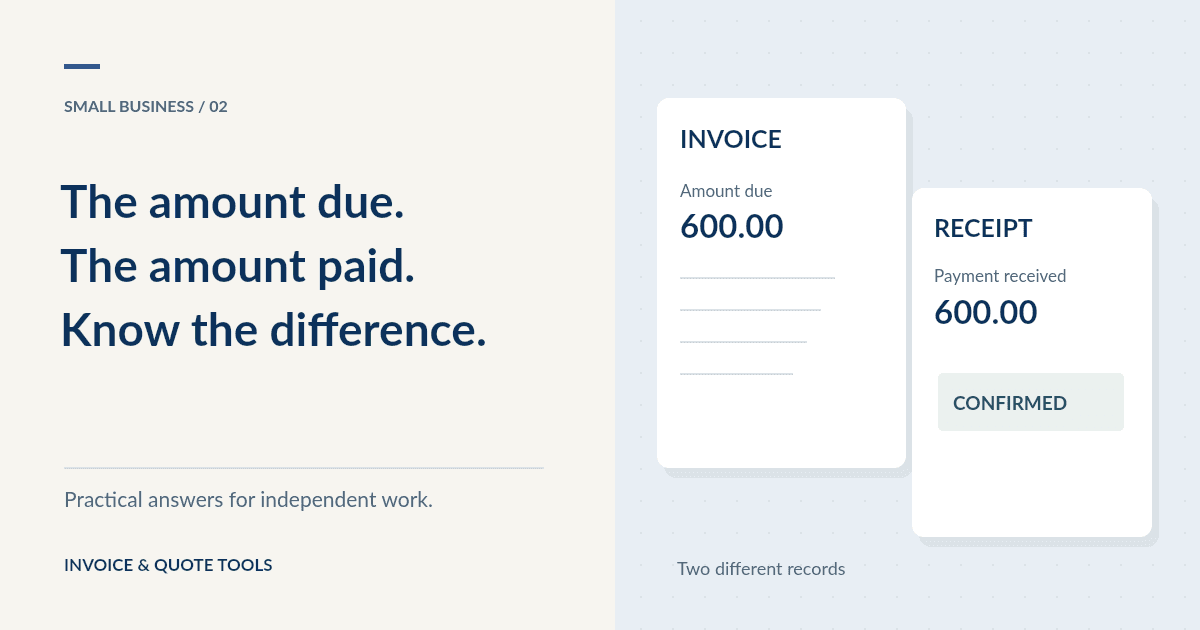
The simplest distinction is purpose: an invoice states what a customer owes for goods or services; a receipt acknowledges a payment received. An invoice can still be unpaid. A receipt should correspond to an actual payment, not merely to a promise to pay.
Timing is useful context, but it is not the whole definition. You can issue an invoice at the same time as payment, or produce a paid invoice afterwards. What matters is whether the document requests or itemizes a charge, records settlement, or clearly performs both functions.
What is an invoice?
An invoice identifies the supplier and customer, describes the transaction, and states the amount charged. It usually has a unique reference, an issue date, and payment instructions. A credit sale may also include a future payment deadline.
For example, a consultant completes an agreed workshop and sends invoice CONS-026 for GBP 600, due on a specified date. That invoice tells the customer what to pay. Sending it does not establish that the consultant received GBP 600.
The document also helps the customer approve the charge. A service description, workshop date, and purchase-order reference can connect the invoice to the original booking. Our step-by-step invoice guide explains how to organize those details.
What is a receipt?
A receipt records money received for a transaction. A useful business receipt identifies the recipient of the payment, the amount and currency, the payment date, and what the payment relates to. A payment reference and the associated invoice number make reconciliation easier.
A receipt for GBP 600 against CONS-026 confirms that particular payment. It should not claim the invoice is fully settled if a balance is still outstanding. If a payment is later reversed or refunded, your records need to show that later event too.
Do not include full card details, online banking credentials, or other unnecessary financial information. A recognizable payment-method description and transaction reference are generally more useful for matching records than sensitive account data.
Invoice and receipt compared
| Question | Invoice | Receipt |
|---|---|---|
| What does it communicate? | The charge and what is due | A payment received |
| Does it prove payment by itself? | No, an unpaid invoice does not | It acknowledges the stated payment, subject to the underlying transaction |
| When might it be issued? | Before payment, at the point of sale, or as the transaction is documented | When a payment is confirmed |
| What reference helps? | A unique invoice reference | A payment/receipt reference linked to the invoice |
| What amount should it show? | Charges, relevant adjustments, and total or balance due | The amount actually received and any remaining balance |
| Can there be several? | Milestone or periodic invoices may cover separate charges | Several receipts may relate to partial payments on one invoice |
Neither label automatically satisfies every tax or accounting rule. The transaction details, business location, and applicable requirements determine what information is needed.
Three practical business examples
A freelancer is paid after delivery
A designer sends an invoice for CAD 900 after an approved milestone. The client pays CAD 900 a week later. The designer matches the bank transaction to the invoice and sends a receipt or clear payment acknowledgement stating the payment date and invoice reference.
The invoice explains the service and amount. The acknowledgement closes the loop. The designer retains both with the project records rather than changing the original invoice into a different transaction.
A client pays in two installments
A business invoices EUR 1,200 and receives EUR 400 first. A receipt should say EUR 400 received, identify the invoice, and show EUR 800 remaining if that is the correct balance. Marking the entire invoice “paid” would be misleading.
When the remaining EUR 800 arrives, record it separately. Two payment entries can settle one invoice without creating a second charge for the same work. Always distinguish the total project price from the installment currently being requested.
A customer pays immediately
A repair business takes payment at collection. Its point-of-sale document may show the itemized service, applicable tax, total charged, amount received, and payment method. Depending on local requirements, that document can perform more than one recordkeeping function.
The key practical test is clarity: a reader should be able to see both what was sold and whether the stated amount has been settled. Do not issue another demand for the same payment simply because the first document was called a receipt.
Keep the documents connected
Use the invoice number as a shared reference in your payment register and receipt. Keep the original sent invoice, any later correction document, the payment acknowledgement, and relevant transaction evidence together. An invoice filename might include the reference and customer code; the receipt can reference the same invoice with a separate payment identifier.
Reconcile against confirmed payment rather than an email saying “payment sent.” Transfers can be delayed, misreferenced, reversed, or received net of fees. If the amount arriving differs from the invoice, investigate and record the explanation instead of quietly changing the original price.
For US businesses, the IRS explains the role of supporting records, including invoices and receipts. What to retain and for how long depends on the records and rules applicable to your business. A browser draft alone is not a complete recordkeeping system.
What our free tool creates
Our free invoice generator creates PDF invoices. You can enter the billing details, describe the work, set the due date, and download the document without an account. You send the file yourself and track settlement separately.
The tool does not process payments, verify bank transactions, or generate a dedicated payment receipt. Do not treat an invoice download as evidence that money moved. If you need to acknowledge payment, produce an accurate receipt or payment confirmation through your own appropriate recordkeeping process.
Frequently asked questions
Can I use a paid invoice as a receipt?
A clearly marked paid invoice can communicate settlement when it identifies the confirmed payment and relevant details. Whether it meets a particular tax, reimbursement, or consumer requirement depends on the jurisdiction and recipient. Ask what supporting evidence is required rather than relying on the word “paid” alone.
Is an invoice the same as a bill?
In everyday business language, “bill” and “invoice” often describe the same amount being charged, viewed from the payer's or supplier's perspective. The label does not change the need to identify the transaction and payment terms clearly.
Should I send a receipt before payment clears?
Do not acknowledge money you have not confirmed receiving. If you need to respond to a client's payment notification, say that you have received their message and will confirm settlement once you can verify it. That avoids representing an expected transfer as a completed one.
What if the client needs an invoice after paying?
Document the actual transaction and avoid requesting payment a second time. Include the relevant paid status or payment acknowledgement where appropriate, use consistent references, and follow any local rules for issuing or correcting the document.
Where should the payment deadline go?
Put it on the invoice, alongside clear payment instructions. A receipt instead records the payment already made. Our guide to Net 15, Net 30 and Net 60 explains how to write a deadline without ambiguity.
Put the guide into practice.
Create an invoice with your details, choose a professional template, and download your PDF. Free, with no signup.
Create Your Free InvoicePractical guides to using invoices and business documents. Examples are illustrative. Tax, invoicing and payment rules depend on your location and circumstances; check the linked official guidance for your situation.