Invoice Payment Terms Explained: Net 15, Net 30, and Net 60
Write deadlines clients can act on. Compare Net 15, Net 30 and Net 60, calculate due dates, and understand early-payment discounts and late-payment wording.
On this page
Invoice payment terms explain when and how the customer should pay. “Net 30” is a useful shorthand, but a client still needs to know when the 30 days start, the currency and amount to pay, and which payment instructions to follow.
The most effective terms are agreed before the work and repeated clearly on the invoice. A deadline introduced for the first time after delivery can create a dispute even if the invoice looks professional. Use the examples below as drafting aids, then adapt them to your actual agreement and applicable rules.
What Net 15, Net 30 and Net 60 mean
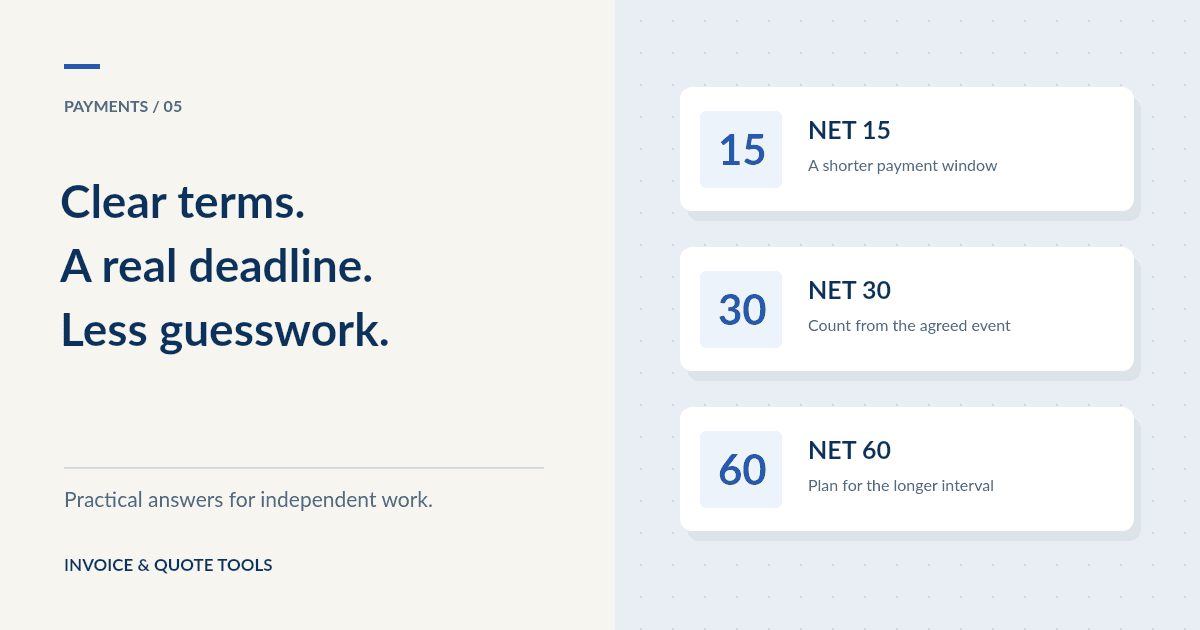
“Net” generally refers to the full amount payable under the stated terms. Net 15, Net 30 and Net 60 commonly allow 15, 30 or 60 days from an agreed starting event. That event may be the invoice date, receipt of a valid invoice, or another trigger defined in the contract.
Do not assume that the phrase alone settles the starting event or every counting rule. Put a specific due date on the document and make sure it agrees with the contract. For international clients, write the month in words in payment instructions rather than relying only on a numeric date.
| Term | Common intended meaning | What to make explicit |
|---|---|---|
| Due on receipt | Pay when the invoice is received | The agreed process and what receipt means |
| Net 15 | Full payment within 15 days | The starting event and actual due date |
| Net 30 | Full payment within 30 days | Whether the clock starts from issue, receipt, or another agreed event |
| Net 60 | Full payment within 60 days | That the extended period was agreed and fits applicable rules |
| Payment in advance | Pay before the defined work or supply proceeds | The amount, deadline, and what happens after payment |
| Milestone payment | Pay when a specified project stage is billable | The stage, amount, approval conditions, and payment deadline |
These are common commercial descriptions, not a statement that any term is lawful or appropriate for every transaction.
How to calculate a due date
First identify the agreed starting date. Then apply the agreed number of days and any business-day or holiday provisions. For this illustrative table, the parties have agreed calendar days counted from the invoice date, 1 November 2026, with no weekend or holiday adjustment.
| Agreed term | Example deadline |
|---|---|
| Net 15 from invoice date | 16 November 2026 |
| Net 30 from invoice date | 1 December 2026 |
| Net 60 from invoice date | 31 December 2026 |
A month is not always 30 days. “End of month,” “30 days after month end,” and “Net 30” can produce different dates. If the contract uses an end-of-month arrangement, write out the intended deadline rather than shortening it to a different term on the invoice.
Make the date and instructions agree
For a USD 1,000 service invoice, a straightforward instruction might be:
Payment of USD 1,000 is due by 1 December 2026, Net 30 from the invoice date of 1 November 2026. Pay by the agreed bank-transfer method and quote invoice WEB-2026-014. Verified recipient details are provided below.
Replace the example reference and payment details with your own information. If the actual agreement starts the clock on receipt, do not copy wording that starts it on the issue date. Keep evidence of delivery or portal submission where it matters to the payment process.
Early-payment discounts explained
An early-payment discount is conditional: the customer receives it only if they meet the stated conditions. For example, “2/10, Net 30” commonly describes a 2% discount for payment within 10 days, with the full balance otherwise due within 30 days of the agreed starting event.
Define the amount the discount applies to, when payment must be received, and what happens to the balance if it is not taken. Tax treatment and the handling of discounts can vary, so do not assume the discount always reduces tax in the same way.
For an illustrative USD 2,000 fee with no tax in the example:
- A 2% early-payment discount is USD 40.
- The discounted payment is USD 1,960 if the stated conditions are met.
- Otherwise, USD 2,000 remains payable by the agreed final deadline.
If the starting date is 1 November 2026 and calendar-day counting is agreed, the early deadline in this example is 11 November and the Net 30 deadline is 1 December. Write both dates clearly so the payer can choose the correct amount.
Avoid reducing the invoice too early
The discount controls in our free invoice generator apply an immediate fixed or percentage reduction to the invoice total. They do not automatically determine whether a future early-payment condition has been met.
For a conditional offer, describe the agreed conditions and dates in Payment terms and use an appropriate recordkeeping process to apply and reconcile the discount when earned. Do not enter a 2% global discount simply because you are offering “2/10, Net 30”; that would present the lower total before the customer qualifies.
Late-payment terms need a separate check
Explain the due date and agreed consequences clearly, but do not assume you can add any fee you choose. Contractual charges, statutory interest, notice requirements, consumer protections, and collection procedures depend on the jurisdiction and transaction.
GOV.UK explains when a commercial payment becomes late within the UK framework. This does not establish the rule for another country or every UK customer relationship. US state rules, Canadian provincial rules, and European national implementation can differ. Verify the rules that actually apply before including a percentage, fixed charge, or legal-rights statement.
An overdue reminder can remain useful without asserting a penalty. Identify the invoice, amount, and due date; ask for its approval status and a payment date. Our freelancer invoicing guide includes a practical reminder email.
Choose terms that fit the engagement
Choose terms with the client before delivery, considering both your ability to finance the work and the client's approval process. A short deadline is not helpful if the customer has already agreed a different cycle or cannot submit an invoice until supplier onboarding is finished.
For a small defined task, you might agree payment on completion or a short period afterwards. For a larger project, a deposit and milestone invoices may distribute the funding requirement. For a recurring service, specify the billing period and whether each invoice covers work in advance or arrears.
Assess the arrangement as a whole: the amount exposed, the duration of the work, previous payment experience, and the client's purchasing requirements. This is a commercial decision, not a reason to assume that Net 30 is always best or Net 60 is always unacceptable. Any chosen arrangement still needs to meet the applicable rules.
Add payment terms to your invoice
In the invoice editor, set the issue date and due date, then use Payment terms for the instructions the payer needs. Include the reference, currency, agreed method, and relevant conditions. The date fields and written terms are editable separately; changing one does not automatically rewrite the other.
Check the final document in Review PDF. Confirm that the deadline appears consistently, the bank details are correct, and a conditional discount has not been applied as an immediate reduction by mistake. Download the PDF and send it through the client's agreed channel.
If you are assembling your first invoice, start with the invoice creation checklist. After payment arrives, record the confirmed amount and date separately; an invoice is not the same as a receipt.
A final terms check before sending
Read the invoice and agreement together. Can the customer identify the exact deadline and the event it is based on? Is the currency explicit? Are conditional discounts explained without making the balance ambiguous? Are any late-payment provisions actually agreed and applicable?
Clear terms cannot guarantee payment, but they can remove uncertainty about what the customer is expected to do next. Keep the wording short enough to act on and detailed enough to match the agreement.
Put the guide into practice.
Create an invoice with your details, choose a professional template, and download your PDF. Free, with no signup.
Create Your Free InvoicePractical guides to using invoices and business documents. Examples are illustrative. Tax, invoicing and payment rules depend on your location and circumstances; check the linked official guidance for your situation.